Showing posts with label Bengali films. Show all posts

Saturday, 19 April 2014

অযান্ত্রিক (The Pathetic fallacy)


"Humari filmo ki tarah, humari zindagi mein bhi 
end tak sab kuch thik hi ho jaata hai... happy's ending"--

                                                                                                          -- OM SHANTI OM (2007)

This is one of the popular dialogue of the Bollywood blockbuster movie "OM SHANTI OM". Apart from happy endings, what else we can expect from the Bollywood movies?

Let's go back to the 50's era, when Bollywood was not so popular but romantic stories were always there with more drama. 
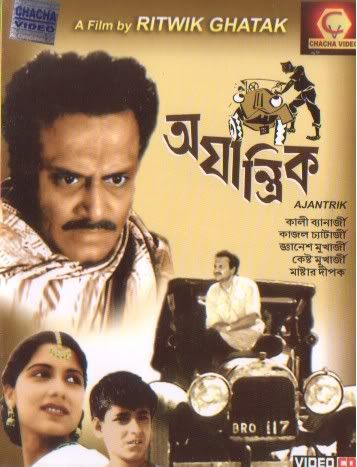
AJANTRIK(1958)

This Bengali film "AJANTRIK" is also about a love story. The protagonist character Bimal (actor Kali Banerjee) falls in love with Jagaddal. Yes, that's the name Bimal has given.

"Jagaddal" is a 1920's Chevrolet jalopy taxi, that Bimal drives everyday to earn his bread. He is driving this car for 15 years and he takes good care of it as any other living being. 

Director Ritwik Ghatak tried to portray a relationship between human being and machine, by creating a communication between them. There is one scene in the movie where Bimal feeds the car with a bottle of water as if it is thirsty after traveling some kilometers. The background sound of a human being drinking water, gives birth to a new life inside "Jagaddal". In fact, it is now a living character of the movie  with a name.

This film reminds us that we are all surrounded by objects. It can be a pen, paper, books, some gifts, etc. Every object tries to establish some kind of communication with us. As if they are alive & at the same time no. We are going through a period where we are in love with the machines without even realizing it. 

"AJANTRIK" is a classical example of modern society. The visuals of this movies are important to watch without closing one's eyes for a moment. Those who don't understand Bengali language, they can even connect with the film that it wants to portray, without looking at the subtitles. This is because of the beautiful way of story telling with less dialogues and a stunning performance by actor Kali Banerjee.

Love can be expressed in many ways but not necessarily with human invented words. It's a feeling to connect like the way things around us do.      

Monday, 17 March 2014

মাটির ময়না (The Clay Bird), Dir. Tareque Masud


আমার সোনার বাংলা,


আমি তোমায় ভালবাসি।


চিরদিন তোমার আকাশ,

তোমার বাতাস

আমার প্রাণে বাজায় বাঁশি।

This song is written by the poet Rabindranath Tagore in the year 1905 following the Partition of Bengal by the then viceroy of India, Lord Curzon. The first 10 lines of this song later constitute the national anthem of Bangladesh just after the "Bangladesh Liberation war" in the year 1971.

THE CLAY BIRD

This film is set during the pre-liberation war just before the birth of "Bangladesh". It's about a conservative muslim family, where life seems to be moving on a regular routine but the political situation of the country (East Pakistan then called) brings a lot of tension along with disaster in the end.

The young protagonist character Anwar (Nurul Islam bablu) was sent to Madrasha (Islamic religious boarding school) by his religious father Kazi (Jayanto Chattopadhyay). In fact it reflects the director's own experience in Madrasha school during the period of Bangladesh Liberation war. Kazi is a homeopathic pharmacist & according to him " ALLOPATHY IS THE TREATMENT OF DISEASE WHERE AS HOMEOPATHY IS THE TREATMENT OF PATIENT".

Kazi's brother Milon (Soaeb Islam) is a true Marxist supporter and their mentalities don't match though their ideologies like both Homeopathy & Marxology came from the same path i.e. Germany.

The film portrays various historical incidents of that era through human experience of the young protagonist character. Unfortunately, tragedy strikes his family with sudden death of his sister due to his father's (Kazi') refusal to use Western antibiotics, and a terrifying attack by the Pakistani troops on their village to prevent Bangladeshi Independence. "The Clay Bird" deeply reminds Satyajit Ray's childhood epic of rural India "Pather Panchali" to show the nature through simple observation of a child.

Because of the political turmoil, people in general were confused between religion & politics at that time. Some people like Kazi were supporting Pakistan because they were unable to accept the reality of brutal killings of their Islamic brothers from West Pakistan. But at last it raises question of mixing up Political and extreme religious views. 


The literary translation of this song of the movie means " Our mind is like a bird which is imprisoned inside the cage made up of human body". The music of this film represents the folk culture as well as baul. Words are very impressive and can make anyone feel free.


Saturday, 11 January 2014

Interview (1971)


Are we ashamed of wearing dhotis?

I think there is no answer to this question but rather another question can be asked, i.e. What?

Now the present scenario is, the more we neglect our own culture, the more important we feel. In fact this attitude always existed even when we were under the Communist government.
India got independence in the year 1947 from the British rule. By the way, what independence we are talking about?

Interview

Mrinal Sen’s “Interview” is about an entire day of a man (Ranjit Mallick) in 1970, where he struggles to appear for an interview of an Indo-British firm in the city of Calcutta. Here in the film, he fulfills all the criteria to get the job except one important thing. One formal black suit is required to appear for the interview. It is the most vital requirement for this job.

The film is made in a documentary style, where camera follows the protagonist character Ranjit Mallick. It brings the audience into a communication medium, where they can start asking questions to the protagonist character who intends to search for a suit throughout the film to borrow from his friends but at last fails to manage it.

Just because of a suit you didn’t get the job? Are you feeling sad?

Of course the answer is “YES”. Now the main question for the reader of this blog:

Who is responsible for this misfortune?

Currently, we are more concerned about wearing branded clothes than our own handmade products.

Gandhi (wearing dhoti) with Charkha /spinning wheel

The Khadi movement was started by Mohandas Karamchand Gandhi in the year 1918 with an ideology that Indians should be self reliant on Hemp and free themselves from the high priced goods & clothes that the British were selling to them. Gandhi promoted the spinning of Khadi (hand-woven cloth) for rural self employment & later started only wearing Dhoti. Thus it symbolizes his ideology of independence.

Nowadays the trend is going towards the exchange of culture & the modernization of technology where the term independence is again looking for a new meaning.

Saturday, 21 December 2013

পরশুরাম (The man with the Axe)

We all are running to make our own identity. Sometimes we are already born with it or we chase towards making it later in our life. But how many people on this earth are living without it?


I haven't thought about this before I saw the film "Parashuram". This is about a rural migrant (played by Arun Mukherjee) who comes to Kolkata in search of work. He always carries an axe on his shoulder & preserves the strange memory of his encounter with a tiger. He believes the axe to be lucky for him and can eliminate any fear of his life.

Every character in general is identified by a name. But the man has no identity in this film. He mixes up with the other rural migrants on street & starts living with an old beggar at an abandoned graveyard. He was given a name "Parashuram" by the fellow rural migrants. Why the name "Parashuram"?


Arun Mukherjee as "Parashuram"

"Parashuram" was the sixth incarnation of Lord Vishnu and he was born during the Treta Yuga. According to Hinduism, there are four ages/yugas titled as : Satya Yuga, Treta Yuga, Dvapara Yuga, Kali Yuga. These four ages are part of a greater cycle of existence, known as a Manvantara & is a significant feature of many other cosmic cycles, notably the four seasons of the year, the four weeks of the lunar month, the four ages of human life & the four points of the compass. At present we are passing through Kali Yuga, one of the darkest of all other ages.

Parashuram- the sixth avatar of lord Vishnu

Parashuram was a devotee of Lord Shiva and he received a Parshu (weapon-Axe) from him as a boon. Thus the name "Parashurama" was given to him. It is believed that he is immortal and still lives on this earth. He will even teach war skills to Kalaki, the tenth avatar of Lord Vishnu, who is to come on earth at the end of Kali Yuga.

So in this film, why they call him "Parashuram"?. Just because he carries an axe like Parashuram or something else?
Well, there is a belief among the people that, Parashuram is still alive in our Kali Yuga who will save the world from destructions like he did during the Treta Yuga by exterminating all of the ruling class, namely the Kshatriyas, from the face of the earth 21 times with his gifted Axe from Lord Shiva.

Parashuram in a battle against Kshatriyas 

Like Treta Yuga, many people are made to suffer now in a different form. Many people are starving daily on earth and spend their entire life without an identity or value to leave here after their last breath. 


Monday, 25 November 2013

নীল আকাশের নীচে (১৯৫৯)


The film is based on a short story “চিনী ফেরিয়ালা (Chinese Vendor)” by Mahadevi Verma. Set in the background of the last days of British era in Calcutta(1930s), the film explores the lives of a number of characters including a Chinese immigrant Wang Lu (played by Kali Bandopadhay).

He is from a small village in China & was living there with his sister. But destiny brought him here in India in search of livelihood. While selling clothes he comes across a traditional Bengali house where he meets Basanti (played by Manju Dey). She is a supporter of non-violent mass movement against the British Government. She doesn’t use foreign made clothes but couldn’t refuse Wang Lu of buying the Chinese made table cloth.
Basanti & Wang Lu

Who would have imagined that in future (2013 currently), world market along with India would be flourished with Chinese made products?

Wang Lu expresses his gratitude by getting a warm welcome from Basanti where other houses were not so receptive. After that he keeps on coming to her house not to sell clothes but to get the warm appreciation that he doesn’t usually get from other people. Slowly he develops a feeling for her.

   
This lovely song (lyrics-Gauri Prasanna Mazumdar) sung by Hemanta Mukhopadhay is a question to the river about its origin & where is it flowing to. River has got a universal language of feelings. We try to understand each other’s sentiment but our language is not as simple as river. The song tells a lot about the inner emotion of Wang Lu, who wants to share something in a simple way of river. It is indeed true for every immigrant who wants to share their feelings with the people of different origin but we don’t always go with the flow.

With the declaration of Indian National Congress Party illegal by the British Government in 1932, Basanti was jailed for some years leaving behind a platonic relationship between her & Wang Lu. During that period, the Chinese Civil War was going on & due to the political turmoil in China, Wang Lu realized that he is needed there. But he is not ready to leave for his hometown without having a glimpse of her.


The Chinese Culture reflects through the background music of this film & tunes into the rhythm of Indian scales. Human emotions are also like the scales of music where a harmonious melody is required to understand each other. 

Wednesday, 20 November 2013

আশ্চর্য প্রদীপ (২০১৩)

Based on the short story of Shirshendu Mukhopadhay, this film is directed by Anik Dutta(his second feature film & he is already popular with his witty script & dialogues). It is made especially for the Bong audience as it involves every emotion of the Bengali people. Here the protagonist character ANILDA(played by Saswata Chatterjee) is a middle-class Bengali man who works at a company for sales promotion & lives with a typical ambitious Bengali wife(Sreelekha Mitra) who is jealous of her brother in law for their high profile lifestyle.


The title "আশ্চর্য প্রদীপ" meaning "ASTONISHING LAMP" plays an important role by creating a world of fantasy in the audience's mind before watching the film like me.


Frustrated with the normal stagnant life, ANILDA (If you jumble the word, it comes like  A /A N ) by coincidence found a lamp on the side of a street. He then took it to his house unaware of something magical inside the lamp.
Anilda truly believes in numerology & 4 is his lucky number. He always try to relate every incident in his life like buying lottery, finishing a task on a particular date, buying property etc. with his belief of lucky number 4.Director Anik Dutta, also introduced the concept of numerology in his first movie “BHOOTER BHABISHYAT”.

At one point of time we all get frustrated when life seems to be static & we look for a change. In real life change may or may not come but in the film “আশ্চর্য্য প্রদীপ ” a দৈত্য  (genie played by Rajatava Dutta) comes out of the lamp & fulfills the materialistic desires of Anilda.
What are the desires? Here comes the main part of entertainment as well as the transformation we have been through these decades.
Since we are aware of the fantasy, comedy film “GOOPY GYNE BAGHA BYNE”(1969) directed by Satyajit Ray that is based on 3 boons given by the king of Ghosts in a forest to 2 village men who were roaming around to sing for the people without any demand of power, money, status etc.


At that point of time there were few options but less confusion. People knew about their particular desire & they were happy. But now the scenario is different. I am sharing one song of the movie "ASCHORJYO PRODEEP"


These songs can’t be compared but director Anik dutta with his impressive lyrics & whimsical sense of humor has shown the changes we have undergone for the last few decades & if we get a chance in our real life, we won’t be able to choose our happiness. Even 3 boons are not sufficient nowadays to fulfill our unlimited desires. We are running towards something shallow & are moving away from happiness.


Here the story of this film continues to move on a circle leaving behind one question— What is happiness?