Wednesday, 2 April 2014

El próximo oriente (The Near East)

Love has no language. It can be felt anywhere & anytime. Love has no boundary unless there is any intervention from the person's cultural background or past.


El próximo oriente

In this film, a Bangladeshi expat Aisha (played by Spanish actress Nur Al Levi) in Madrid, gets pregnant & later ditched by a Spanish guy (played by Asier Etxeandia) living next door. Her father runs a Bangladeshi restaurant without liquor in the menu because of the religious issue.

Director Fernando Colomo takes the story to a different level where the brother Caín (played by Javier Cifrián) of the Spanish guy who ditched the Bangladeshi girl Aisha,  starts helping her after she tried to commit suicide. Though it sounds serious, things move on in a comical way when Caín starts impressing her father & agrees to marry her by sacrificing his own religion but casually. He makes it clear to Aisha, that this marriage is meant to help her out of depression and family conflict. Slowly this comical and complicated relationship converts into a romantic one.

Being Bengali, I find these British actors playing Bangladeshis very different. I can't relate their way of speaking Bengali language and acting with ours. Something is missing--"HACE FALTA" -- that's how we say in Spanish.

Comparing this film with an American film "OUTSOURCED", the story is different but the cultural intervention of both the countries- America and India,  makes it more or less clear to watch. where as on the other hand "El próximo oriente" missed out the cultural intervention of Spain & Bangladesh, which is important for this context of the story. Apart from showing religious differences, the film didn't show much about the culture of Spain and as a result it creates some questions among the audiences.

The story is good and funny to enjoy. The Spanish actors have delivered impressive performances on screen that hold the story altogether. But for the Asian audiences, the film misses out the spicy flavor because the script involves the culture, language and comical relationship between Spain and Bangladesh.    


Monday, 24 March 2014

Hotel Rwanda, Dir. Terry George

Everywhere on this planet, there are various incidents of the past, where we have made distinctions of our country people based on religion, caste, status, colors of skin, etc.

SO WHO STARTED THIS DISTINCTION?

Of course, we humans, but we made distinctions of ourselves based on the remarks of the people whom we consider so called, superior to "us"
Let me be clear with this "us" factor.

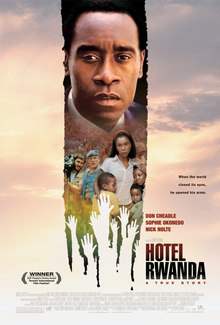
Hotel Rwanda

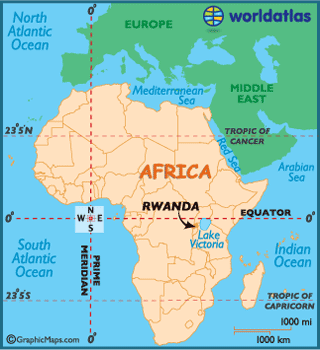
The film "Hotel Rwanda" is based on a true incident of genocide that took place in the land locked country of Rwanda between the two tribes- Hutu & Tutsis in the year 1994.

Map of Rwanda

This incident went almost unnoticed by the rest of the world. This film was made after 10 years, that portrays the real truth of hatred and it makes me do some research on GOOGLE about the place & the history. Since it involves the first world as well as third world countries, so "us" factor is very controversial here. if I say, I want to specify only "Blacks" & "Dark skinned people" as "us" then I am still on the road of hatred based on racial discrimination.

During the year of 1994, the murder in the plane crash of the President of the African state of Rwanda was used as an excuse for the country's majority ethnic group, the Hutus, to launch a genocide massacre of their hatred rivals, the Tutsis. This hatred started since 1962, when Rwanda got independence from the colonial rulers of Belgium.  Before leaving the country, they operated a divide & rule policy by giving preference to the Tutsi minority based on their facial sharp structures & less darkened skin colors in matters of employment and education. Just like the British did before departing from India in the year 1947.

The movie concentrates on the true story of Paul Rusesabagina (played by american actor Don Cheadle), a well educated Hutu, with a Tutsi wife Tatiana (played by british actress Sophie Okonedo) and three small children. He is the manager of Kigali's( Rwanda's capital) luxurious 4 star Hotel des Mille Collines, owned by Sabena airlines.

Paul didn't have any idea, what he is capable of before the outburst of genocide. He used to believe one thing for his job ("I was told never to lower the tone of the hotel") & his wife and children ("Family is all that matters"). Gradually, Paul is seen to grow as a man to save the lives of 1268 Tutsi and Hutu refugees by giving them shelter into the hotel and taking big risks like bribing, lying & threatening to the soldiers without giving up any hope.

When no help is forthcoming from the western powers & black people are left  to their fates, Paul realizes which side he is on & his remarks " How can I not intervene?" reflects the true mankind of helping each other without even thinking about any difference, that he has learned to achieve during the genocide where 500000 innocent people lost their lives.

The film with its impressive cinematography & overwhelming performance by the actors, creates a bonding with the audience to feel the pain of the helpless people during that period. The soundtrack of the movie completes the circle after watching the film with its wonderful lyrics....


Monday, 17 March 2014

মাটির ময়না (The Clay Bird), Dir. Tareque Masud


আমার সোনার বাংলা,


আমি তোমায় ভালবাসি।


চিরদিন তোমার আকাশ,

তোমার বাতাস

আমার প্রাণে বাজায় বাঁশি।

This song is written by the poet Rabindranath Tagore in the year 1905 following the Partition of Bengal by the then viceroy of India, Lord Curzon. The first 10 lines of this song later constitute the national anthem of Bangladesh just after the "Bangladesh Liberation war" in the year 1971.

THE CLAY BIRD

This film is set during the pre-liberation war just before the birth of "Bangladesh". It's about a conservative muslim family, where life seems to be moving on a regular routine but the political situation of the country (East Pakistan then called) brings a lot of tension along with disaster in the end.

The young protagonist character Anwar (Nurul Islam bablu) was sent to Madrasha (Islamic religious boarding school) by his religious father Kazi (Jayanto Chattopadhyay). In fact it reflects the director's own experience in Madrasha school during the period of Bangladesh Liberation war. Kazi is a homeopathic pharmacist & according to him " ALLOPATHY IS THE TREATMENT OF DISEASE WHERE AS HOMEOPATHY IS THE TREATMENT OF PATIENT".

Kazi's brother Milon (Soaeb Islam) is a true Marxist supporter and their mentalities don't match though their ideologies like both Homeopathy & Marxology came from the same path i.e. Germany.

The film portrays various historical incidents of that era through human experience of the young protagonist character. Unfortunately, tragedy strikes his family with sudden death of his sister due to his father's (Kazi') refusal to use Western antibiotics, and a terrifying attack by the Pakistani troops on their village to prevent Bangladeshi Independence. "The Clay Bird" deeply reminds Satyajit Ray's childhood epic of rural India "Pather Panchali" to show the nature through simple observation of a child.

Because of the political turmoil, people in general were confused between religion & politics at that time. Some people like Kazi were supporting Pakistan because they were unable to accept the reality of brutal killings of their Islamic brothers from West Pakistan. But at last it raises question of mixing up Political and extreme religious views. 


The literary translation of this song of the movie means " Our mind is like a bird which is imprisoned inside the cage made up of human body". The music of this film represents the folk culture as well as baul. Words are very impressive and can make anyone feel free.


Tuesday, 18 February 2014

Sicko, Dir. Michael Moore


(1) "Do you have any health insurance?" --- This is the first question asked before admitting any patient in the private hospitals of India.

(2) "How much health insurance do you have?" --- this is the vital question. Treatment depends upon the answer. That's where the corruption creeps in. 

India, where the majority of the population lives under poverty line, these private hospitals are earning their profits unwisely without following any rules or regulations. In fact, they have their own health policy, which is affordable only by a small fraction of rich people in India.


Now coming back to the award winning documentary "SICKO", director Michael Moore, has shown the profit-oriented health maintenance organizations(HMO) in United States which is similar with the corrupted health system of India.  Getting life insurance in US depends upon meaningless terms & conditions. Many people in US are living without any life insurance and they have no adequate money to afford for their treatment where as in countries like England, Canada, France etc people over there don't worry about paying before undergoing any treatment in hospitals. Free universal health care system makes life meaningful without having the fear of losing one's entire life income to become a victim of profit making health system. 

Here in the documentary, 3 rescue workers of 9/11 were chosen by the director to represent the abusive health system of US. After the traumatic incident of 9/11, these 3 workers were considered as heroes at that time for saving so many lives, sacrificing their own health. Now after 5 years of 9/11, no one in America remembers these real life heroes when they are suffering from different health related symptoms that came while rescuing people from World Trade Center and they don't have enough money for their treatment. US Government doesn't want to take any responsibility for their treatment.


CUBA


"CUBA" is considered as a dangerous place with leftist ideology for americans in US. Government intervention is there everywhere. So how can the health system be left without any government intervention and guess what, treatment in Cuba is very cheap, almost free in comparison to US.

So what do you think? Is it possible for these rescue workers to get proper & affordable treatment in CUBA?

If you want to know, then you must watch the documentary to have a fair idea about some amazing health systems that are unbelievable for the people of developed nations like US and developing nations like India.

"IF YOU CAN FIND MONEY TO KILL PEOPLE, YOU CAN FIND MONEY TO HELP PEOPLE" --- Tony Benn (British Labour Party Politician)

Thursday, 23 January 2014

DIEZ MINUTOS, Alberto Ruiz Rojo

"The golden rule is that there are no golden rules"-- George Bernard Shaw

Though most of us try to be law abiding citizen, we all break rules everyday intentionally or unintentionally. When we are on a smooth ride of our journey of life, rules play perfect symphony with our law abiding nature until we experience new path of life. It can be rough or more smooth than before.

What makes us different among the other species of our planet is the ability to think. Rules are invented as well as broken by us. But WHY?

DIEZ MINUTOS (10 mins)


Here in the Spanish short film "DIEZ MINUTOS", a man (played by Gustavo Salmerón) calls a customer service operator (played by Eva Marcel) in search of an information to connect him with his girlfriend. The conversation starts with a mechanical exchange of words where the organized stiffness of the operator refuses to help him with the information which is against the Company's rule. The man keeps on requesting the operator, to give him the information available to them which can save him getting detached from his girlfriend forever. The conversation goes on &  on, to pull the hidden emotion out of the operator, so that she can understand his state of mind as an human perspective instead of acting as a machine. But she sticks to her Company's rule of not leaking out the information, which is of vital importance to him at this moment. 

Is she mean? She has feeling? Is she afraid of overcoming the rules? ...

                                                        WHAT DO YOU THINK?

It's a long debate to come across any particular conclusion but before that, one must see this short-film to experience a whack on the head, so that we can use our COMMON SENSE instead of thinking too much about logic.


Thursday, 16 January 2014

Outsourced, John Jeffcoat


Do you like spicy food? –
Well it depends upon every individual but for me of course I do.
Anyway, that is the introduction of my country India in this American movie “Outsourced”. It is quite popular outside India as it gives a complete idea about the Indian culture in brief. Those who haven’t been to India and would like to visit in future, it is one of the best films to watch before landing here rather than watching films like “Slumdog millionaire” that gives a vague perception of India.


Here in the film, an entire department of a call center in Seattle was outsourced, where Todd (Josh Hamilton), an American novelty products salesman, heads to India to train his replacement Puru (Asif Basra). Right from the Mumbai airport, the film shows how it feels to be in a place that is so different from one’s own motherland.
For us Indians, it is funny to watch our own way of doing things which is strange for foreigners to understand, especially for the people on their first visit in the land of Kali (goddess of destruction).

This film provides a lot of information about both the countries (India & USA) of how they are different from each other culturally and in many other aspects through funny conversations & very impressive way of story-telling. Though both the countries were ruled by the British, there is a huge difference of English pronunciation of Indian & American accent. Todd got frustrated of not being able to train the Indian employees to change their accent, so that the MPI(Minutes per Incident) level improves and they don’t get caught as Indians over the telephonic conversation with US citizen. Then Asha (Ayesha Dharker), a woman employee over there, suggested Todd to learn more about India.

Slowly things start rolling for positive results when Todd begins to learn more about the Indian culture, keeping in mind that a fellow American call center trainer told him “Once he stopped resisting India, it got better”. Impressed by the suggestion of Asha, he promoted her for the position of future assistant of Puru.
When MPI level improved to Todd’s target 6, his supervisor flew down to India, only to announce that the company has been outsourced to China & everyone is fired. Todd was given the same job to train his replacement in China. But at last he refused to go to China and instead came back to US leaving behind a complicated relationship with Asha. He discovered before leaving India that Asha was already engaged with another man by her family since she was only 4 years old. According to her, the intimate moment they spent together can be given a name “Holiday in Goa”.

Apart from Indian culture, we can also learn few American terms from this movie. I was not aware of some terms before watching it. So I am ending like an American way –


BREAK A LEG... ;)


Saturday, 11 January 2014

Interview (1971)


Are we ashamed of wearing dhotis?

I think there is no answer to this question but rather another question can be asked, i.e. What?

Now the present scenario is, the more we neglect our own culture, the more important we feel. In fact this attitude always existed even when we were under the Communist government.
India got independence in the year 1947 from the British rule. By the way, what independence we are talking about?

Interview

Mrinal Sen’s “Interview” is about an entire day of a man (Ranjit Mallick) in 1970, where he struggles to appear for an interview of an Indo-British firm in the city of Calcutta. Here in the film, he fulfills all the criteria to get the job except one important thing. One formal black suit is required to appear for the interview. It is the most vital requirement for this job.

The film is made in a documentary style, where camera follows the protagonist character Ranjit Mallick. It brings the audience into a communication medium, where they can start asking questions to the protagonist character who intends to search for a suit throughout the film to borrow from his friends but at last fails to manage it.

Just because of a suit you didn’t get the job? Are you feeling sad?

Of course the answer is “YES”. Now the main question for the reader of this blog:

Who is responsible for this misfortune?

Currently, we are more concerned about wearing branded clothes than our own handmade products.

Gandhi (wearing dhoti) with Charkha /spinning wheel

The Khadi movement was started by Mohandas Karamchand Gandhi in the year 1918 with an ideology that Indians should be self reliant on Hemp and free themselves from the high priced goods & clothes that the British were selling to them. Gandhi promoted the spinning of Khadi (hand-woven cloth) for rural self employment & later started only wearing Dhoti. Thus it symbolizes his ideology of independence.

Nowadays the trend is going towards the exchange of culture & the modernization of technology where the term independence is again looking for a new meaning.