Sunday, 15 June 2014

"A story should have a beginning, a middle and an end... but not necesarily in that order"


"All's well that ends well"

We are all familiar with this phrase/play of William Shakespeare. A story may have a beginning, a middle but the most important thing is the ending that holds the base of any story line, whether it is predictable or not.

But what happens when the story doesn't end the way it should be?


Christopher Nolan, introduced a wonderful way of storytelling in his movie "MEMENTO". Here the story is about an insurance company investigator Leonard Shelby (Guy Pearce), whose wife gets raped and murdered & he was left alive and injured by the culprit with a brain damage. He suffers from a short term memory loss but not to be confused with amnesia. Leonard seeks for the revenge of his wife's murderer.

The story is narrated out of sequence, with some scenes in monochrome, and at a hectic rate. This gets us involved into the film to use our own memories to reconstruct the chronological narrative. Director Nolan has used the technique of showing every sequence of the movie like the game of jumble words. The scratches on Leonard's cheek- where did they come from? Having essential information tattooed on his body- who did this and when? Meeting the attractive barmaid Natalie (Carrie-Anne Moss)-- why he wants to meet her suddenly or is she using him on the other way round? 

Thus while watching the movie, we question our own perception of the world.

"But even if you get revenge you're not gonna remember it. You're not even going to know that it happened" Natalie tells Leonard somewhere in between the movie. 

So where does the story end? It's hard to reconstruct our own memories but with a line "Where was I?"


If we go back little earlier, Quentin Tarantino brought a new technique of story telling in his movie "PULP FICTION (1994)" which is considered as one of the Hollywood classic. Apart from classy style, the ending of the movie makes us wonder when John Travolta moves out of a restaurant with Samuel L.Jackson, when we see him killed inside an apartment sometimes back into the movie. 

So where does the story end? ... 


Monday, 21 April 2014

Jolly LLB


"Tarikh par tarikh, Tarikh par tarikh, Tarikh par tarikh.... 
par insaaf nahi mila milod, 
bas mili hai to sirf Tarikh"
                                                             
                                                                      -DAMINI (1993)


We all Indians agree with this dramatic and true dialogue of the Bollywood film "DAMINI", delivered by the actor Sunny Deol (not to be confused with Sunny Leone), who criticized the corrupted judicial system of India. The majority of the cases in India are pending, awaiting the dates of next hearing. It repeats on & on like a circle.

Before scrolling down, watch this creative output of the "GREEN PLYWOOD" ad below, that is entertaining for the Indians as well as audience abroad, an overview of the slowest & funny system of Indian court. One can commit crime in India & can survive by delaying trials for a lifetime.


"The first thing we do, let's all kill the lawyers." When Justice Rajendra Mal lodha quoted from Shakespeare's Measure for Measure on March 15 last year, a wave of mirth ran through courtroom 5 of the "Supreme Court". It was in response to a case seeking to stop a film, Jolly LLB, from being released.

Now coming to the national award winning feature film Jolly LLB, it's about a young lawyer Jagdish Tiyagi aka Jolly (actor Arshad Warsi) from Meerut, who wants to go to Delhi, the ultimate place of  Sab-Court-Ka-Baap "Supreme Court", to gain media popularity & make it big.

Jolly LLB

Here actor Boman Irani plays the role of Tejinder Rajpal (a highly influential & corrupted lawyer) who is defending a businessman, guilty of driving under the influence of alcohol & killing people sleeping on the street of Delhi (inspired by 1999 hit and run case of Sanjeev Nanda). Rajpal can win this case very easily and is capable of playing tricky games to change the truth into a different story. During the ongoing trial inside the court, Jolly becomes Rajpal's fan instantly and without thinking much files a PIL (Public Interest Litigation) against Rajpal's client and comes under the media attention.

Now starts the real game of politics, where lawyers use their intelligent skills to keep the corrupted system of India follow the same path without any diversion. The real battle begins between experienced Rajpal & newcomer Jolly. 

Boman Irani's performance  as a professional & corrupted lawyer will make the audience seated until the end of the movie.

At last, why experienced professionals like Rajpal in the movie are corrupted and newcomers like Jolly are confused to support corruption or fight for Justice? 

Whatever it may be, enjoy the movie where CORRUPTION here is one of the main ingredient of ENTERTAINMENT.  


Saturday, 19 April 2014

অযান্ত্রিক (The Pathetic fallacy)


"Humari filmo ki tarah, humari zindagi mein bhi 
end tak sab kuch thik hi ho jaata hai... happy's ending"--

                                                                                                          -- OM SHANTI OM (2007)

This is one of the popular dialogue of the Bollywood blockbuster movie "OM SHANTI OM". Apart from happy endings, what else we can expect from the Bollywood movies?

Let's go back to the 50's era, when Bollywood was not so popular but romantic stories were always there with more drama. 

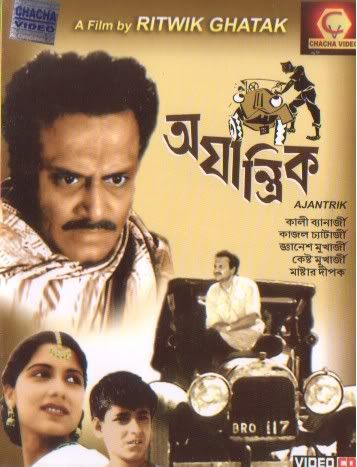
AJANTRIK(1958)

This Bengali film "AJANTRIK" is also about a love story. The protagonist character Bimal (actor Kali Banerjee) falls in love with Jagaddal. Yes, that's the name Bimal has given.

"Jagaddal" is a 1920's Chevrolet jalopy taxi, that Bimal drives everyday to earn his bread. He is driving this car for 15 years and he takes good care of it as any other living being. 

Director Ritwik Ghatak tried to portray a relationship between human being and machine, by creating a communication between them. There is one scene in the movie where Bimal feeds the car with a bottle of water as if it is thirsty after traveling some kilometers. The background sound of a human being drinking water, gives birth to a new life inside "Jagaddal". In fact, it is now a living character of the movie  with a name.

This film reminds us that we are all surrounded by objects. It can be a pen, paper, books, some gifts, etc. Every object tries to establish some kind of communication with us. As if they are alive & at the same time no. We are going through a period where we are in love with the machines without even realizing it. 

"AJANTRIK" is a classical example of modern society. The visuals of this movies are important to watch without closing one's eyes for a moment. Those who don't understand Bengali language, they can even connect with the film that it wants to portray, without looking at the subtitles. This is because of the beautiful way of story telling with less dialogues and a stunning performance by actor Kali Banerjee.

Love can be expressed in many ways but not necessarily with human invented words. It's a feeling to connect like the way things around us do.      

Friday, 4 April 2014

El próximo oriente

El amor no tiene idioma. Se puede sentir en cualquier lugar y en cualquier momento. El amor no tiene límites a no ser que intervengan el pasado o la cultura de la persona.

El próximo oriente

En este película, una imigrante de Bangladesh llamada Aisha (Nur Al Levi) que vive en Madrid, se queda embarazada de su vecino (Asier Etxeandia), quien no quiere hacerse responsable y la abandona. El padre de la chica tiene un restaurante donde no sirve alcohol por cuestiones religiosas, ya que es musulmán.

El director Fernando Colomo continúa la trama donde el hermano del chico, Caín (Javier Cifrián) empieza a ayudar a la chica de Bangladesh después de que ella intenta a suicidarse. Suena serio pero la historia se transforma en una comedia cuando Caín empeza a impresionar a la padre de la chica y terminar casándose con la chica, convirtiéndose a su religión por casualidad. Aunque él aclara a la chica que su matrimonio es solo para ayudarla a salir de su depresión y de su conflicto familiar, poco a poco la relación cómica y complicada que tienen se convierte en una relación romantica.

Siendo Bengali, me parece extraño ver a actores británicos haciendo los personajes de Bangladesh. No puedo identificarme con su manera de hablar Bengali y ni con su manera actuar, aunque imiten nuestro movimientos y nuestra lengua materna. Falta algo.

Esta película me ha recordado a una película americana, llamada "OUTSOURCED" donde la historia es diferente pero la intervención cultural de los países India y América se ve claramente en la película. Por otro lado, en "El próximo oriente" no se ha aprovechado la intervención cultural de España y Bangladesh, que es importante para el contexto de la historia. Más allá de la diferencia religiosa, la película no muestra mucho sobre la cultura de España y por lo tanto crea algunas preguntas entre los espectadores. 

La historia es entretenida. Los actores españoles han actuado de forma impresionante en la pantalla, lo que ha mejorado la historia. Pero para los espectadores asiáticos, a la película le falta el sabor porque la historia no incluye suficientemente  las culturas, los idiomas y la relación entre España y Bangladesh.


Wednesday, 2 April 2014

El próximo oriente (The Near East)

Love has no language. It can be felt anywhere & anytime. Love has no boundary unless there is any intervention from the person's cultural background or past.


El próximo oriente

In this film, a Bangladeshi expat Aisha (played by Spanish actress Nur Al Levi) in Madrid, gets pregnant & later ditched by a Spanish guy (played by Asier Etxeandia) living next door. Her father runs a Bangladeshi restaurant without liquor in the menu because of the religious issue.

Director Fernando Colomo takes the story to a different level where the brother Caín (played by Javier Cifrián) of the Spanish guy who ditched the Bangladeshi girl Aisha,  starts helping her after she tried to commit suicide. Though it sounds serious, things move on in a comical way when Caín starts impressing her father & agrees to marry her by sacrificing his own religion but casually. He makes it clear to Aisha, that this marriage is meant to help her out of depression and family conflict. Slowly this comical and complicated relationship converts into a romantic one.

Being Bengali, I find these British actors playing Bangladeshis very different. I can't relate their way of speaking Bengali language and acting with ours. Something is missing--"HACE FALTA" -- that's how we say in Spanish.

Comparing this film with an American film "OUTSOURCED", the story is different but the cultural intervention of both the countries- America and India,  makes it more or less clear to watch. where as on the other hand "El próximo oriente" missed out the cultural intervention of Spain & Bangladesh, which is important for this context of the story. Apart from showing religious differences, the film didn't show much about the culture of Spain and as a result it creates some questions among the audiences.

The story is good and funny to enjoy. The Spanish actors have delivered impressive performances on screen that hold the story altogether. But for the Asian audiences, the film misses out the spicy flavor because the script involves the culture, language and comical relationship between Spain and Bangladesh.    


Monday, 24 March 2014

Hotel Rwanda, Dir. Terry George

Everywhere on this planet, there are various incidents of the past, where we have made distinctions of our country people based on religion, caste, status, colors of skin, etc.

SO WHO STARTED THIS DISTINCTION?

Of course, we humans, but we made distinctions of ourselves based on the remarks of the people whom we consider so called, superior to "us"
Let me be clear with this "us" factor.

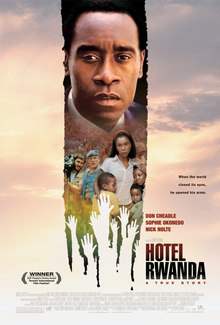
Hotel Rwanda

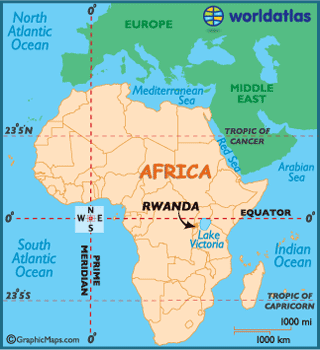
The film "Hotel Rwanda" is based on a true incident of genocide that took place in the land locked country of Rwanda between the two tribes- Hutu & Tutsis in the year 1994.

Map of Rwanda

This incident went almost unnoticed by the rest of the world. This film was made after 10 years, that portrays the real truth of hatred and it makes me do some research on GOOGLE about the place & the history. Since it involves the first world as well as third world countries, so "us" factor is very controversial here. if I say, I want to specify only "Blacks" & "Dark skinned people" as "us" then I am still on the road of hatred based on racial discrimination.

During the year of 1994, the murder in the plane crash of the President of the African state of Rwanda was used as an excuse for the country's majority ethnic group, the Hutus, to launch a genocide massacre of their hatred rivals, the Tutsis. This hatred started since 1962, when Rwanda got independence from the colonial rulers of Belgium.  Before leaving the country, they operated a divide & rule policy by giving preference to the Tutsi minority based on their facial sharp structures & less darkened skin colors in matters of employment and education. Just like the British did before departing from India in the year 1947.

The movie concentrates on the true story of Paul Rusesabagina (played by american actor Don Cheadle), a well educated Hutu, with a Tutsi wife Tatiana (played by british actress Sophie Okonedo) and three small children. He is the manager of Kigali's( Rwanda's capital) luxurious 4 star Hotel des Mille Collines, owned by Sabena airlines.

Paul didn't have any idea, what he is capable of before the outburst of genocide. He used to believe one thing for his job ("I was told never to lower the tone of the hotel") & his wife and children ("Family is all that matters"). Gradually, Paul is seen to grow as a man to save the lives of 1268 Tutsi and Hutu refugees by giving them shelter into the hotel and taking big risks like bribing, lying & threatening to the soldiers without giving up any hope.

When no help is forthcoming from the western powers & black people are left  to their fates, Paul realizes which side he is on & his remarks " How can I not intervene?" reflects the true mankind of helping each other without even thinking about any difference, that he has learned to achieve during the genocide where 500000 innocent people lost their lives.

The film with its impressive cinematography & overwhelming performance by the actors, creates a bonding with the audience to feel the pain of the helpless people during that period. The soundtrack of the movie completes the circle after watching the film with its wonderful lyrics....


Monday, 17 March 2014

মাটির ময়না (The Clay Bird), Dir. Tareque Masud


আমার সোনার বাংলা,


আমি তোমায় ভালবাসি।


চিরদিন তোমার আকাশ,

তোমার বাতাস

আমার প্রাণে বাজায় বাঁশি।

This song is written by the poet Rabindranath Tagore in the year 1905 following the Partition of Bengal by the then viceroy of India, Lord Curzon. The first 10 lines of this song later constitute the national anthem of Bangladesh just after the "Bangladesh Liberation war" in the year 1971.

THE CLAY BIRD

This film is set during the pre-liberation war just before the birth of "Bangladesh". It's about a conservative muslim family, where life seems to be moving on a regular routine but the political situation of the country (East Pakistan then called) brings a lot of tension along with disaster in the end.

The young protagonist character Anwar (Nurul Islam bablu) was sent to Madrasha (Islamic religious boarding school) by his religious father Kazi (Jayanto Chattopadhyay). In fact it reflects the director's own experience in Madrasha school during the period of Bangladesh Liberation war. Kazi is a homeopathic pharmacist & according to him " ALLOPATHY IS THE TREATMENT OF DISEASE WHERE AS HOMEOPATHY IS THE TREATMENT OF PATIENT".

Kazi's brother Milon (Soaeb Islam) is a true Marxist supporter and their mentalities don't match though their ideologies like both Homeopathy & Marxology came from the same path i.e. Germany.

The film portrays various historical incidents of that era through human experience of the young protagonist character. Unfortunately, tragedy strikes his family with sudden death of his sister due to his father's (Kazi') refusal to use Western antibiotics, and a terrifying attack by the Pakistani troops on their village to prevent Bangladeshi Independence. "The Clay Bird" deeply reminds Satyajit Ray's childhood epic of rural India "Pather Panchali" to show the nature through simple observation of a child.

Because of the political turmoil, people in general were confused between religion & politics at that time. Some people like Kazi were supporting Pakistan because they were unable to accept the reality of brutal killings of their Islamic brothers from West Pakistan. But at last it raises question of mixing up Political and extreme religious views. 


The literary translation of this song of the movie means " Our mind is like a bird which is imprisoned inside the cage made up of human body". The music of this film represents the folk culture as well as baul. Words are very impressive and can make anyone feel free.